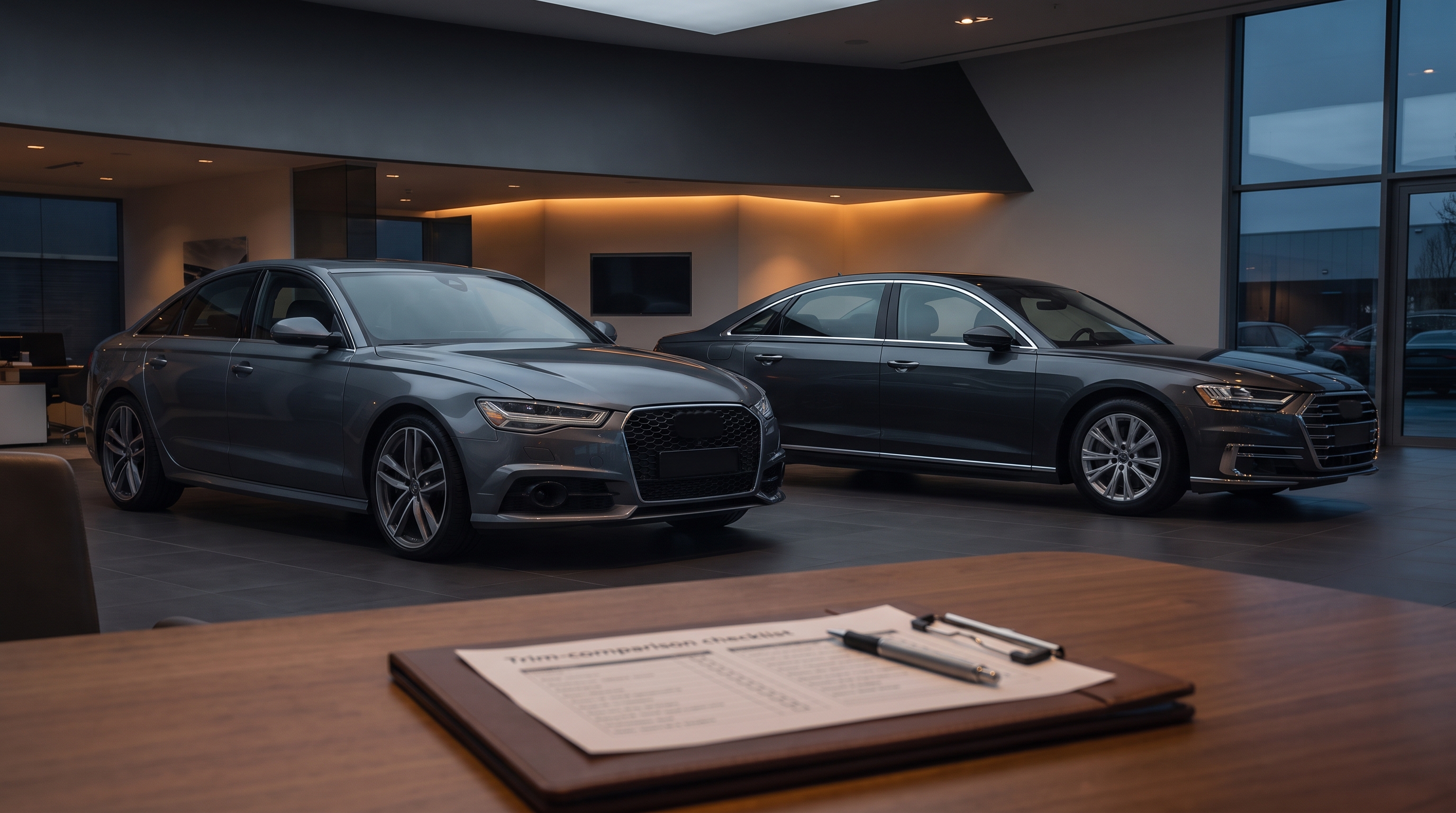
Two cars, or three at most. That is how many vehicles belong on a final shortlist — the list you carry into test drives, insurance quotes, and price checks. Two or three is enough for a real comparison and small enough that you will actually finish the decision.
Why Two or Three Cars Beats a Bigger List
Every finalist costs real time. Each one needs a test drive, an insurance quote, a look at real asking prices in your area, and — for used cars — a history check and inspection. Two or three finalists fit into one or two weekends. Six finalists turn into a month of scattered appointments, and most shoppers stall before the end.
Small lists also make differences visible. When you compare a hybrid hatchback against a midsize SUV, the tradeoffs jump out: cargo floor height, fuel stop frequency, parking. When you compare six similar crossovers, everything blurs into “pretty good,” and the brochure starts making the decision instead of you.
What Goes Wrong With Too Many Finalists
Three failure patterns show up again and again:
- The endless loop. Each time choosing gets uncomfortable, a new candidate joins the list. The search restarts instead of resolving, and weeks disappear.
- The paper tie. Spec sheets make almost every modern car look competent. The information that actually decides the purchase — seat comfort, sightlines, how the throttle responds in traffic — does not live on a spec sheet.
- Comparison burnout. After the fourth back-to-back test drive in a weekend, impressions smear together. More data, worse signal.
The False Read: A Longer List Means More Thorough
This one deserves a direct callout because it feels true. Saving nine cars feels like diligence. In practice, thoroughness comes from checking a few cars deeply — driving them on your actual roads, pricing your actual trim, quoting your actual insurance — not from skimming nine cars shallowly. A long shortlist is usually avoidance wearing a productivity costume.
Cut the Big List With Hard Filters
Work in this order and let each filter finish its job before moving to the next:
- Total budget ceiling. Monthly payment plus insurance, fuel or charging, and expected upkeep for your mileage. This kills more candidates than any other filter.
- Non-negotiables. Seat count, cargo volume for your gear, towing, garage or parking fit, winter capability.
- Dealbreakers. Anything that disqualifies a car regardless of its strengths — a cabin you already know you dislike, a size that does not fit your space.
- Duplicates. If two candidates fill the same role, keep the stronger one and cut the other. You need options, not echoes.
Most oversized lists collapse quickly under filters one and two. If yours does not, your filters are probably preferences, not requirements.
An Illustrative Example
Consider an illustrative example, not a real case. A shopper saves nine cars across a few evenings of swiping. A firm total monthly budget removes three. A requirement for a rear seat that fits two child seats side by side removes two more. Noticing that two of the remaining four are the same model in different trims removes one more. That leaves three finalists: a compact SUV, a wagon, and a hybrid sedan — three genuinely different answers to the same brief. Two weekends of drives and quotes, and the decision is made.
The cuts took about twenty minutes. Drifting would have taken weeks.
What to Compare at the Finalist Stage
Keep the comparison itself small. For two or three cars, look at:
- Total cost for your usage, not sticker price — your mileage, your insurance profile, your fuel or charging situation.
- Daily fit. Commute, school run, hardware store runs, the parking spot at work. A car that is perfect on paper and wrong on Tuesday is the wrong car.
- How it drives. Only answerable in person. This is the item the whole shortlist exists to serve.
- Real availability. Especially for used cars: does a clean example of that trim and mileage actually exist near you? If not, the finalist is theoretical.
Where CarSwype Match Fits
CarSwype Match is built around this rhythm. Swipe wide early — judging a few hundred cars at a glance is exactly what the discovery stage is for. Save contenders as you react to them, and write a private note at the moment of reaction: “seats look flat,” “love the window line,” “too wide for the garage.” Notes captured in the moment beat notes reconstructed a week later.
Then use the compare view on your two or three finalists, with your own notes attached. One caution: the lifestyle copy and pros-and-cons text in the app are editorial prompts for your own thinking, not vehicle evidence. Anything factual you care about — specifications, safety ratings, efficiency figures, tow ratings — should be confirmed against official sources before it influences the final call. And the app is a discovery and comparison tool, not a substitute for test drives, inspections, financing or insurance checks, or market pricing data.
When Four Finalists Is Reasonable
Two or three is the default, not a law. Carry four when your requirements are rare — accessibility conversions, a specific towing-plus-transmission combination, a body style with thin inventory. In thin markets, first verify which finalists actually exist within reach, then shrink back to three. The number bends; the principle — small enough to finish — does not.
The Two-Sentence Test
Before you book any drives, run this check on each finalist: can you explain in two sentences why this car is on the list? If you cannot, it is a save, not a contender. And if every remaining finalist passes but you still cannot choose, the list is probably too similar — cut a near-duplicate and the choice usually clarifies on its own.
Finish Outside the App
The shortlist stage ends; it does not conclude. Drives, inspections, quotes, and official numbers make the final call. Where possible, drive your finalists back to back on the same day over the same roads, because memory flattens fast. For used cars, get an inspection from an independent mechanic and review the vehicle’s history before money moves. Confirm financing terms and insurance quotes for the specific model and trim. Check official sources for any specification, safety, or efficiency figure that matters to your decision.
The screen work narrows the field. The real world picks the winner.