The Direct Answer: Match the Car to the Job
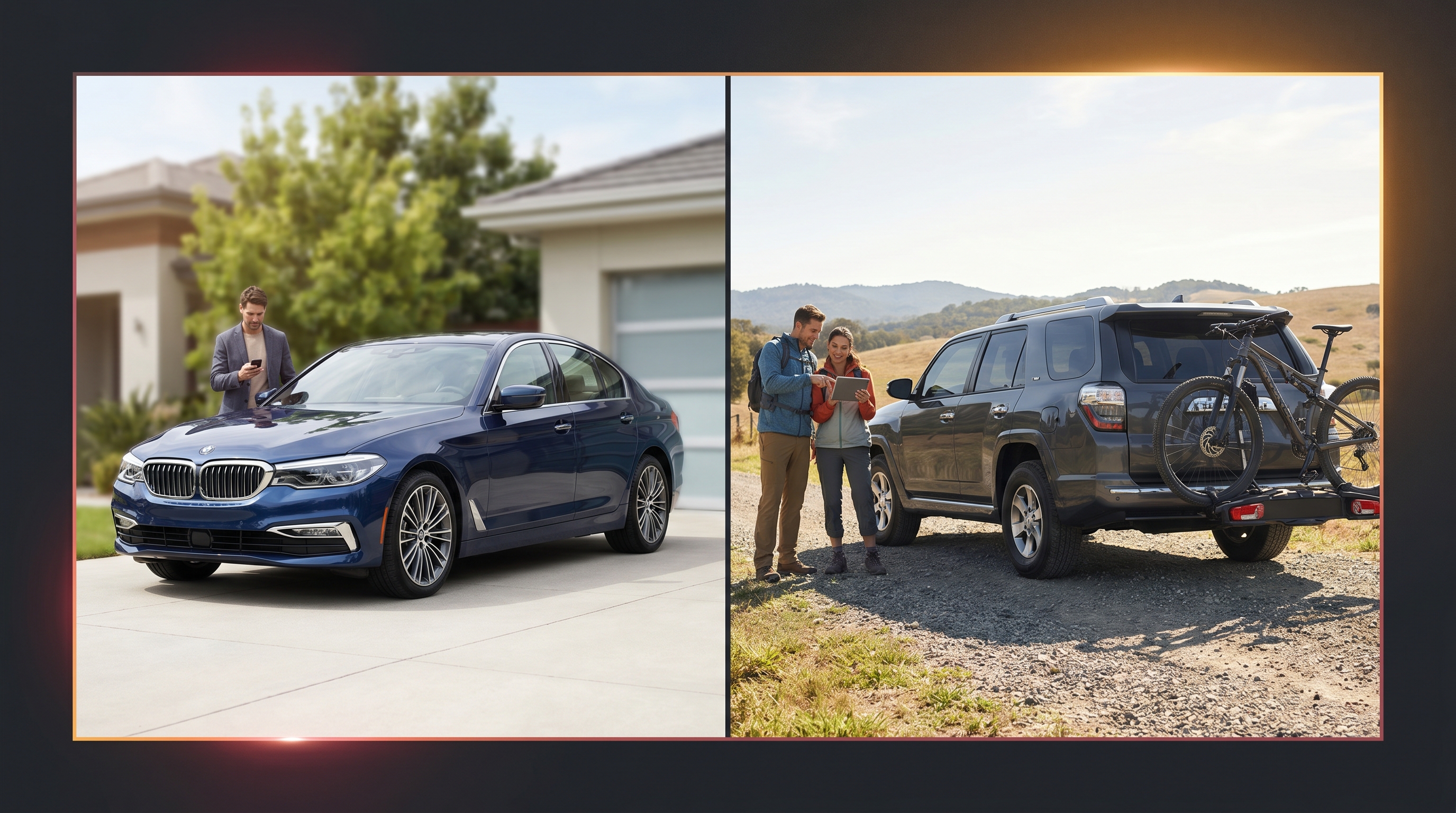
Choose a sedan if your primary driving consists of daily commuting, highway cruising, and parking in tight urban spaces. Choose an SUV if your routine regularly involves hauling bulky gear, navigating deeply rutted driveways, or towing a trailer. The most effective way to decide between an SUV and a sedan is to separate the practical jobs you need the vehicle to perform before you ever look at body styles or badges.
Buyers often approach the car shopping process by comparing specifications on paper. They look at horsepower, cargo volume, and wheelbase without first establishing what their specific lifestyle demands. Reversing this process—defining the job first, then finding the right tool—prevents overspending on capability you will never use.
Defining the Driving Jobs
Every vehicle performs a set of jobs for its owner. These jobs range from moving a single commuter through morning traffic to transporting a Little League team and their equipment. When shoppers struggle to choose between an SUV and a sedan, it is usually because they have not clearly separated these tasks. They feel the pull of SUV versatility but wonder if they actually need it.
Start by listing the physical tasks you expect the car to complete over a typical month. Do you need to load a double stroller without bending down? Do you parallel park on a crowded street every day? Write down the actual tasks to see where your needs cluster.
Job 1: Daily Commuting and Fuel Costs
For the pure job of moving people from point A to point B on paved roads, sedans excel. Because they sit lower to the ground and weigh less than SUVs, they require less energy to move. This translates directly to lower fuel consumption.
Aerodynamics play a major role here. Sedans have a sleeker profile, which reduces drag at highway speeds. If your driving profile consists of long highway commutes, a sedan will almost always yield better fuel economy than a similarly sized SUV.
Illustrative example: A driver chooses a mid-size sedan over a mid-size SUV because their 40-mile daily highway commute would cost significantly more in fuel with the heavier, less aerodynamic SUV.
Job 2: Hauling Cargo, Gear, and Pets
If your regular routine involves transporting large, dirty, or bulky items, an SUV is the right tool. The primary advantage of an SUV is its rear cargo area, which is accessed via a liftgate. This design provides vertical space that a sedan’s trunk cannot match.
When you open the liftgate of an SUV, you can slide in tall items—like a mountain bike, a large dog crate, or a piece of flat-pack furniture—without having to angle or force the object. In a sedan, you are limited by the trunk lid and the narrow opening between the rear seats.
Furthermore, SUVs allow you to separate passengers from cargo. If you are transporting a muddy dog or potted plants, you can fold down the rear seats and keep the mess confined to the cargo area, which is usually lined with durable plastic.
Job 3: Navigating Driveways and Weather
Ground clearance is the distance between the bottom of the vehicle and the road. SUVs offer more of it. This becomes critical if you live on an unpaved road, frequently encounter un-plowed snow, or regularly navigate steep driveway approaches.
A sedan low to the ground can bottom out on deep snow or steep transitions, potentially damaging the bumper or undercarriage components. An SUV’s elevated ride height allows it to glide over these obstacles.
However, ground clearance is not a substitute for all-wheel drive. A high-riding SUV with two-wheel drive may still struggle for traction on ice, while a lower sedan with winter tires and all-wheel drive might perform better. The job of clearing obstacles is distinct from the job of gripping slippery surfaces.
Job 4: Urban Parking and Garage Constraints
Physical dimensions matter when parking is tight. Sedans have shorter overall lengths and lower rooflines. This makes parallel parking easier and allows the car to fit into compact parking spots or older residential garages that lack vertical clearance.
SUVs take up more space on the road and in the garage. Their longer doors require more room to open fully in tight parking lots. If you live in a dense urban environment where street parking is the norm, the smaller footprint of a sedan removes a daily source of frustration.
A Common False Interpretation: The Safety Assumption
A frequent failure mode in the car shopping process is assuming that an SUV is automatically safer than a sedan. Shoppers often conflate size and mass with safety, believing that sitting higher and looking down on traffic offers superior protection.
While it is true that the laws of physics favor a heavier vehicle in a collision with a lighter one, modern sedans are engineered with highly advanced structural designs and crash avoidance technology. A newer sedan will often outperform an older, larger SUV in standardized crash tests.
Furthermore, SUVs have a higher center of gravity. This makes them more susceptible to rollovers during emergency evasive maneuvers compared to the flat, stable stance of a sedan. Sitting higher up in an SUV provides a visual command of the road, but it does not inherently make the vehicle safer in all dynamic situations.
How to Use CarSwype Match for Your Decision
CarSwype Match is built for exactly this stage of the car buying journey. When you are torn between distinct body styles, the app allows you to filter by driving vibes and compare contenders side-by-side without getting lost in a spreadsheet of specifications.
Start by searching for the practical jobs you need to be done, such as hauling or commuting. Swipe through both sedans and SUVs that match those vibes. Save contenders from both body style categories into your private shortlist.
Once you have saved a mix of vehicles, use the compare feature to look at two or three options head-to-head. Write private notes on each contender detailing how it specifically fits your driveway, your parking situation, and your weekend errands. This workflow forces you to evaluate the vehicle against your actual life, rather than an abstract ideal.
Choosing between an SUV and a sedan requires an honest assessment of how you spend your time behind the wheel. By defining the jobs you need done first, you can confidently select the right body style and move on to evaluating specific makes and models.