The Short Answer: Pick for Your Worst Loading Day, Not the Brochure
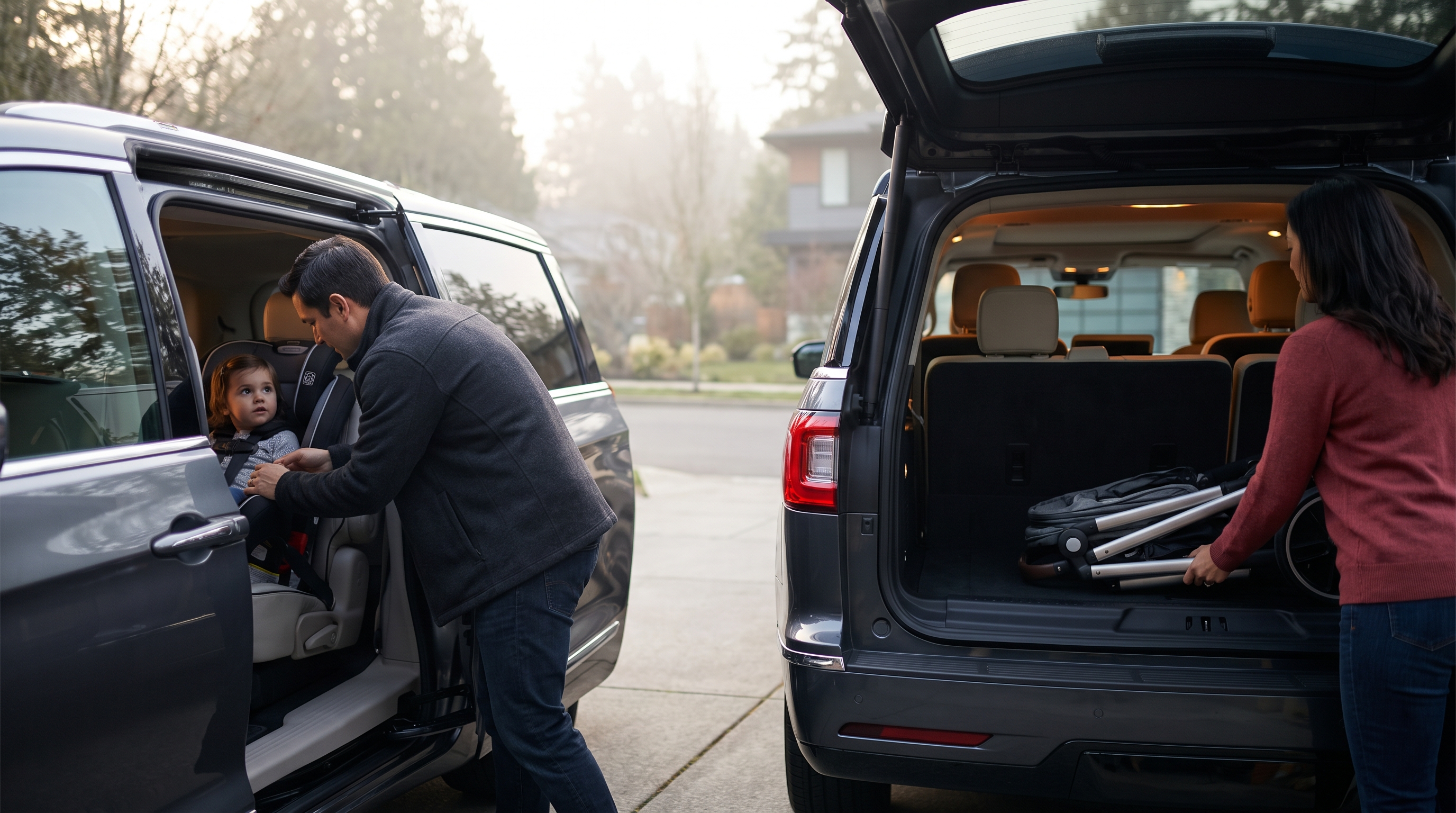
The best body style for a growing family is the one that survives your worst loading day: two car seats installed, a kid who has to climb into a third row, a stroller, and a bag of groceries — all in one trip, in a parking space squeezed between two cars. On that test, a minivan is the strongest answer for families who will actually use a third row with car seats installed. A three-row SUV is the right call when you need all-wheel drive, towing, or ground clearance and use row three only occasionally. And if you have one or two children, a wagon, hatchback, or five-seat SUV is usually enough; paying for a third row years before you need it buys weight, fuel, and cost now for capacity later.
Define Your Veto Tests Before You Fall in Love With a Shape
A veto is a constraint that disqualifies a body style no matter how well it scores elsewhere. Three vetoes decide most family purchases:
Veto 1 — usable seating positions, not the badge. “Seats seven” on a window sticker does not mean seven positions work for children. LATCH (Lower Anchors and Tethers for Children) is the standard anchor system for installing car seats without the seat belt, and many vehicles provide full lower-anchor sets for only two positions; a third rider may be belt-plus-tether only. Lower anchors also carry weight limits — when the combined weight of child plus seat exceeds the limit printed on the seat and in the vehicle manual, you must switch to a seat-belt installation. And forward-facing seats should always use the top tether, which means every position a child will occupy needs a reachable tether anchor. Some third rows don’t have them.
Veto 2 — third-row access with seats installed. This is the test that quietly eliminates most three-row SUVs for families with children in car seats. In most SUVs, row three is reached by tumbling or folding the second row forward. If a car seat is installed in that section, it cannot tumble. The result is a third row you can only use by uninstalling a seat or climbing over an empty second-row position. Minivans pass this veto structurally: sliding doors open wide, and second-row layouts — captain’s chairs with an aisle, or removable or stowable second-row seats in some models — leave a path to the back even with seats installed.
Veto 3 — cargo behind the row in use. Judge cargo with every seat a child occupies upright. Many three-row SUVs leave a shallow shelf behind the raised third row; minivans typically keep a deep, floor-level well that takes a stroller laid flat. Roof boxes patch this for vacation, not for Tuesday.
Why the Minivan Usually Wins at Three Kids or Heavy Carpooling
Three mechanisms do the work. Sliding doors need less clearance than swing doors, so kids can exit in tight parking without dinging the neighboring car, and they open wide enough for a parent to reach a buckle without contorting. The low load floor puts a toddler’s car seat at roughly adult hip height — no deep bend like a sedan, no lift like a tall SUV. And the second-row layouts described above keep the third row real rather than theoretical.
The tradeoffs are real too: some buyers rule out minivans on image (that is opinion, but it is the reason most often given), all-wheel-drive availability is narrower than in SUVs and varies by model year, and towing capacity is generally lower than truck-based rivals.
Where a Three-Row SUV Is the Right Answer
Choose the SUV when your needs include regular towing, serious snow driving on unmaintained roads, or trails — capabilities most minivans cannot match. It can also work when row three is occasional overflow: with two children, one in an installed car seat and one old enough to buckle independently, an empty second-row section can be left free for climbing through.
Before committing, sit an adult in row three for ten minutes; many third rows are sized for children, which is fine if only children will use them. Then load your actual stroller behind the raised third row. If it does not fit flat, either the third row or the stroller is about to become a daily argument.
One or Two Kids? Don’t Buy the Third Row Yet
A wagon gives you a sedan footprint with a large, low cargo box. A hatchback adds flexible cargo to a small footprint. Even a sedan covers two children if the trunk passes the stroller test — bring the stroller to the dealer and try closing the lid before ruling anything out.
Run one extra veto in smaller vehicles: install your rear-facing seat behind the driver’s seat, set for your tallest driver, and check legroom. A tall rear-facing convertible behind a tall driver is one of the most common reasons compact vehicles fail young families, and no spec sheet warns you.
Safety Is a Per-Model Check, Not a Body-Style Feature
The most common false interpretation in family car shopping is “bigger means safer.” NHTSA’s 5-Star Safety Ratings and IIHS ratings apply to specific models, not body styles; a well-rated minivan is not automatically a worse choice than a larger, average-rated SUV, and taller vehicles have historically shown more rollover involvement — one reason size alone settles nothing. Before buying any vehicle: confirm every child position has a usable tether anchor, verify against the owner’s manual, and consider having your installation checked — NHTSA lists free child car seat inspection stations staffed by certified technicians on its website.
Compare Actual Models at fueleconomy.gov, Not Stereotypes
Assume nothing about fuel economy by body style. Official EPA figures for the specific models on your shortlist — including the hybrid and AWD variants you would actually buy — are published at fueleconomy.gov. The yearly gap between two finalists on a school-run commute is a real budget line, not a rounding error.
How to Run This Decision in CarSwype Match
Use the app at the discovery stage: swipe to shortlist body styles against your vibes, save contenders, and write private notes as pass/fail verdicts on each veto — “row three reachable with seat installed: no,” “stroller fits behind row three: untested.” Then compare two or three finalists side by side.
Watch for two failure signals. If your shortlist keeps growing instead of shrinking, you have not applied the vetoes. And when your notes contradict each other (“love the look” next to “can’t reach the third row”), the practical note is the decision.
The Test Drive Is the Final Filter — Bring Props
CarSwype Match ends at the shortlist; it does not replace physical checks, inspections, financing and insurance checks, pricing research, or official vehicle data. Load your actual car seats, your stroller, and your children into each finalist. Install, climb in, load, close the trunk — twice: once as a simulated school morning, once as a road trip. The body style still standing after that is the one to buy.