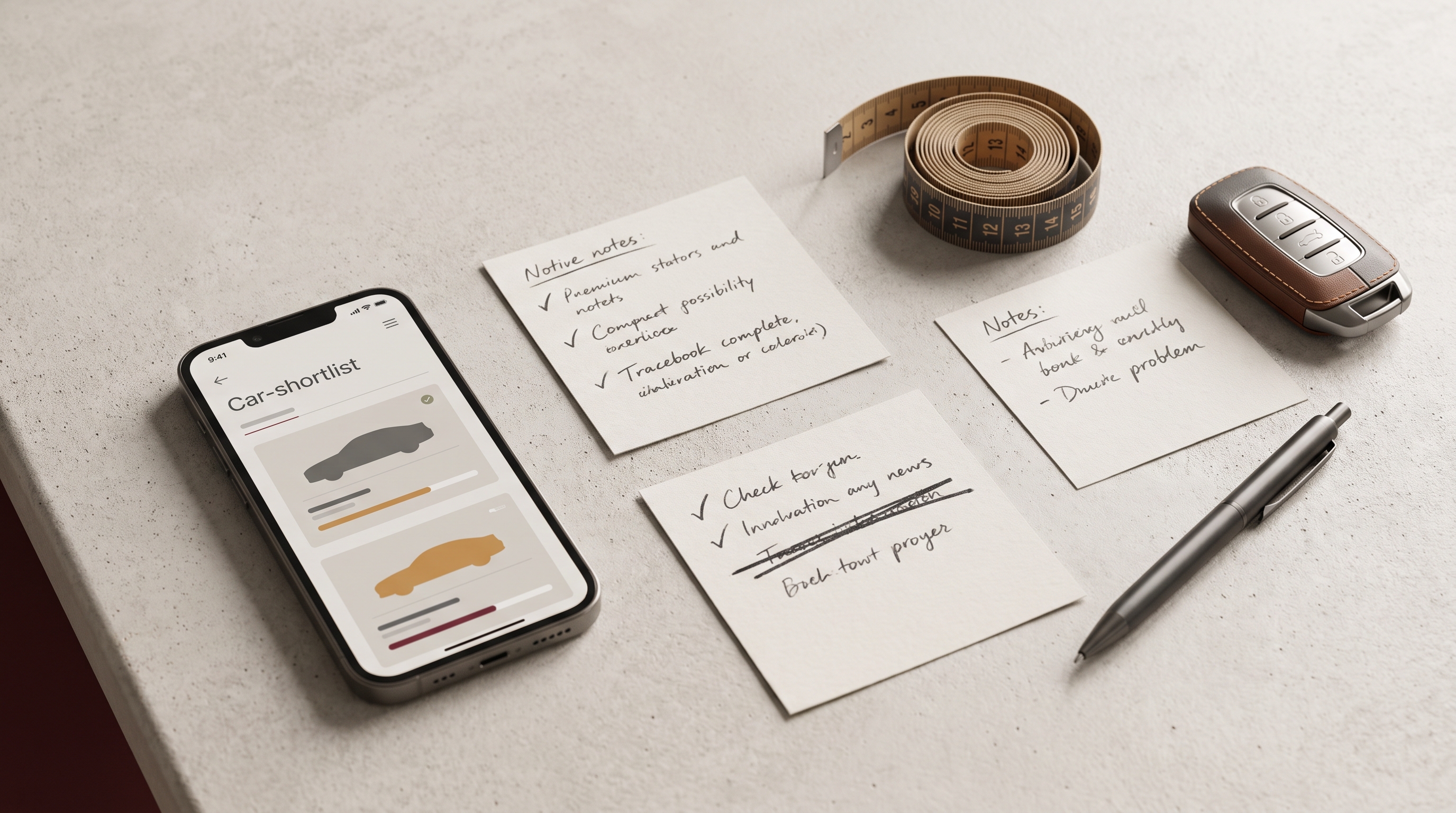
A save in CarSwype Match records that you were interested in a car. It does not record why. Two weeks and eleven saved cars later, “why” is the only thing separating a shortlist from a scrapbook, so the note matters more than the save. Write three things: the specific trigger that made you swipe right, the unresolved questions a spec sheet cannot answer — each with a test that would settle it — and the condition under which you would drop the car. Everything else is decoration.
What a save stores, and what it doesn’t
A swipe is a fast, felt judgment: the cabin felt airy, the price matched the budget in your head. The save preserves the verdict and throws away the evidence, and memory of the evidence fades far faster than the saved card. Your note is a message to the version of you who later has to pick two or three cars to compare. If that future reader cannot reconstruct why the car made the list, the note has failed. Write for them, not for the moment.
The three-part note: trigger, open question, kill condition
Trigger — one sentence, written at save time. It must be specific enough that it could not describe a different car. “Saved because the second row swallowed two car seats without forcing my seat forward” is a trigger. “Saved because it’s practical” is a mood. (Both are illustrative examples.) The trigger is the sentence you reread when the shortlist blurs together.
Open question — an unresolved concern plus the test that resolves it. Format it as question, test, fail line. Illustrative example: “Q: does the trunk take the folded stroller plus a grocery run? Test: measure the folded stroller, check the load-lip height at the dealer. Fail: stroller only fits with a seat folded.” A note like this is a task with a pass/fail outcome; “check trunk” is a mood with a checkbox.
Spec sheets cannot answer these questions because specs are claims about the model and your questions are about your cargo, your family, your commute. Rated cargo volume is a number; whether the stroller fits is geometry. Notes are where the geometry question lives until you can measure it.
Kill condition — the line that, once crossed, removes the car. Illustrative examples: “Drop if all-in monthly — payment plus the insurance change plus fuel — exceeds my ceiling,” or “Drop if the middle second-row seat can’t take a booster next to two adults.” Fit criteria are aspirations; kill criteria are checkable. Shortlists shrink on checkable lines, not on dreams.
What not to write: adjectives, copied specs, marketing echo
Three note types add no signal at compare time:
- Adjectives without mechanisms. “Fun” is unusable because every fun car is fun differently — quick steering, low-end torque, a loud exhaust, a low seat. Rewrite with a cause: “fun = torque from a stop for the short merge ramp.” The mechanism tells you whether another saved car delivers the same fun or a different one you now have to choose between.
- Copied spec-sheet entries. Pasting engine figures or mpg numbers into a note stores data that already lives in official sources and varies by trim and model year; a stale copied number is worse than nothing. If a spec caught your eye, note the question it raised — “claimed range vs. my winter commute, verify” — not the figure.
- Marketing echo. “Award-winning capability” is the brand’s sentence, stored identically on a thousand websites. Your note’s entire value is the one thing no website contains: what happened between you and this car.
Where notes catch what spec comparisons miss
Two cars with near-identical cargo volumes can fit different real objects, because volume is a scalar and fit is shape — load-lip height, opening width, floor flatness with the seats down. “Seats five” and “the middle seat is usable for a teenager” are different claims. These examples illustrate a general pattern, not specific models.
The fix is object-anchored notes. Name the actual things you haul — dog crate, bike with wheels on, two car seats, the ladder from the hardware store — and make “fits / doesn’t fit” the note’s open question. A number can’t fail; an object test can. Falsifiability is what makes later comparison real instead of vibes versus vibes.
The pruning signal: reading your notes to shrink the list
The clearest failure mode is the list that only grows. If fourteen cars are saved and every note is a compliment, your notes contain no vetoes — and comparison cannot start, because detailed comparison works two or three cars at a time; past that, differences flatten into noise.
Two diagnostic reads:
- Contradiction check. If one saved car’s trigger contradicts another’s on the same need — you saved the wagon for family cargo and the coupe for the same weekend trips — your criteria drifted mid-swipe. That is not mess; it is the decision you haven’t made. Name it in a note (“cargo vs. driver feel — decide by the test-drive week”) and re-run the affected saves.
- Generic-positive test. Open every note. If a sentence could appear on any car’s note, it is a non-note. A car whose entire note is generic positives is surviving on the original swipe’s mood alone — that is your first cut.
From notes to test-drive script
Every open question with a test converts directly into the visit: bring the folded stroller, install the car seat, sit behind the wheel at your actual driving position, check the sightlines you would use daily. Notes turn the test drive from a second vibe check into an experiment — you are testing your doubts, not re-liking the car.
This is also the handoff point. CarSwype Match is built for discovery and shortlisting; nothing in the app replaces sitting in the car, a pre-purchase inspection, financing and insurance quotes, or checking a specific vehicle. When a saved car becomes a specific VIN on a specific lot, recall lookups live on NHTSA’s recalls page, and history and title checks with the reporting providers — steps no note can substitute for.
A template to paste into your next note
- Saved because: [one sentence that couldn’t describe a different car]
- Open questions: [doubt + how to test it + the result that fails]
- Must fit: [the real objects you haul]
- All-in ceiling: [payment + insurance change + fuel delta]
- Drop if: [the condition that removes this car]
Write the all-in ceiling once and repeat it in every note. A car can hit a payment ceiling and still lose on insurance or fuel, and a ceiling only disciplines you if it sits next to every car you compare.
A shortlist is working when it shrinks on evidence. Notes are where the evidence lives between the swipe and the seat.