Most car research tools ask the buyer to behave like the decision has already been made.
Pick a body style. Pick a budget. Add fuel type. Sort by price. Remove anything outside the boxes.
That workflow is useful when the shortlist is already real. It is a weak starting point when the buyer is still learning what the boxes should be.
Early car search has a different job: show enough plausible options that the buyer can discover what they keep reacting to, what they keep rejecting, and which constraints are actually hard.
Tabs force premature certainty
The problem is not that filters are bad. The problem is sequence.
When a buyer clicks “SUV” at the beginning, the tool has to pretend that one tab explains the reason. It may not. “SUV” can mean:
- I want to sit higher.
- I need easier child-seat access.
- I carry bulky weekend gear.
- I do not want to feel small on the highway.
- I just do not know the names of the alternatives.
Those reasons do not all point to the same car. A compact crossover, wagon, hatchback, sedan, or minivan could solve different versions of the same request.
Illustrative example: a buyer starts in the SUV tab but keeps liking smaller crossovers and hatchbacks because they are easier to park and cost less to run. A filter-first flow treats those hatchbacks as outside the plan. A reaction-first flow treats the contradiction as useful evidence.
The same thing happens with budget. A buyer may set a strict ceiling, then keep saving cars slightly above it because the cabin, range, warranty, or fuel savings make the tradeoff feel worth checking. The right next step is not to ignore budget. It is to separate purchase price from total cost, monthly payment, insurance, and risk tolerance.
Taste is not the opposite of practical research
Taste sounds soft, but in car shopping it often compresses several practical signals.
A car that “feels right” may be doing concrete work: the size feels manageable, the cabin feels calm, the shape fits the buyer’s self-image, the dashboard looks understandable, or the vehicle does not feel like a compromise before the test drive even starts.
That does not make taste final. It makes taste a useful first signal.
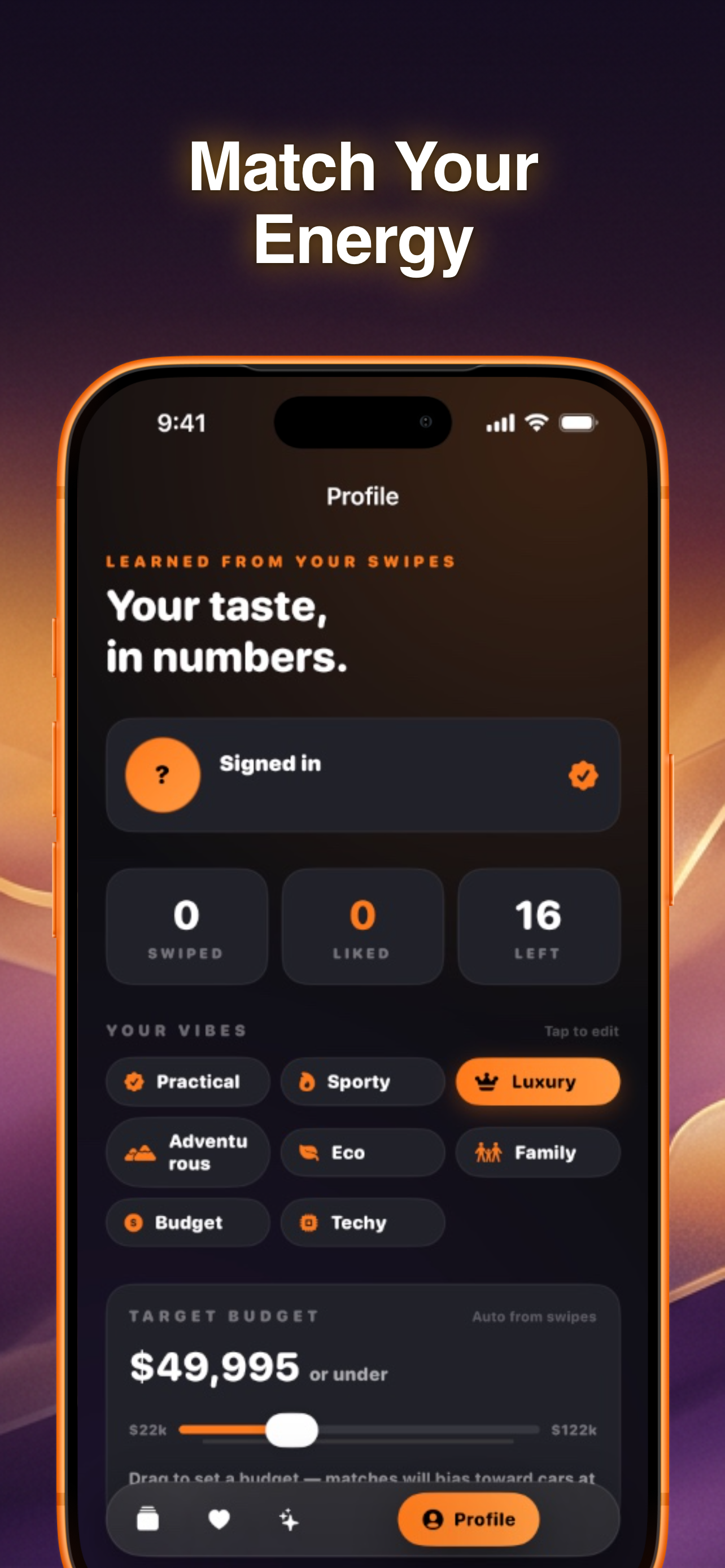
CarSwype Match starts there. The app asks for driving vibes, then lets swipes expose the stronger pattern. A yes or no is faster than a long filter form. More importantly, it lets the buyer react before they are forced to justify the reaction.
Risky interpretation: “The buyer liked premium SUVs, so recommend more expensive SUVs.”
Better interpretation: “Check what survived. Was it the higher seating position, quiet cabin, stronger performance, larger screen, safer-feeling shape, or brand trust?”
Taste narrows the search space. Specs test whether the surviving cars can handle real life.
Hard constraints still get veto power
Reaction-first does not mean constraint-free.
Some requirements should override taste early:
- number of seats
- charging access
- budget ceiling
- insurance cost
- parking space
- cargo needs
- climate and winter range
- accessibility or mobility needs
The mistake is treating every preference as if it has the same weight. “I like the look of this car” and “I cannot charge at home” should not be equal. One is a signal. The other may be a veto.
This is why the best matching flow should keep taste, constraints, notes, and comparison in separate layers. If they get collapsed into one score too early, the buyer cannot tell whether a car is losing because it is boring, too expensive, too small, impossible to charge, or simply shown in a bad order.
The search should learn as the buyer reacts
A good recommendation flow should not require perfect inputs on day one. Buyers change their minds after seeing real options. They learn what they dislike. They discover patterns they would not have typed into a form.
The useful questions are not only “What did the buyer choose?” They are more specific:
- Which body styles keep surviving?
- Which price tier keeps feeling realistic?
- Are running costs pulling harder than performance?
- Are comfort and quietness beating cargo space?
- Which cars deserve notes because the buyer liked them but saw a risk?
Those questions turn swipes into a working profile. The profile should remain editable, because early signals can be noisy. A buyer may like three cars for three different reasons. The app should wait for repetition before treating the pattern as meaningful.
Where comparison belongs
Comparison is most useful after discovery has already removed obvious mismatches.
Comparing ten cars is usually noise. Comparing two or three cars that survived the first reactions is a decision.
CarSwype Match keeps the early flow light, then gives saved cars a more deliberate place: notes, match scores, and side-by-side comparison. That is where the buyer can slow down and ask whether the car that looked right also fits the daily routine.
The result is not a magic answer. It is a cleaner path:
- React to enough cars to expose a pattern.
- Use constraints to remove cars that cannot work.
- Save the cars that still feel worth checking.
- Add notes for the unresolved risks.
- Compare the few cars that deserve real attention.
That sequence respects how people actually shop. They do not begin with a perfect requirements document. They begin with a reaction, then learn what that reaction meant.