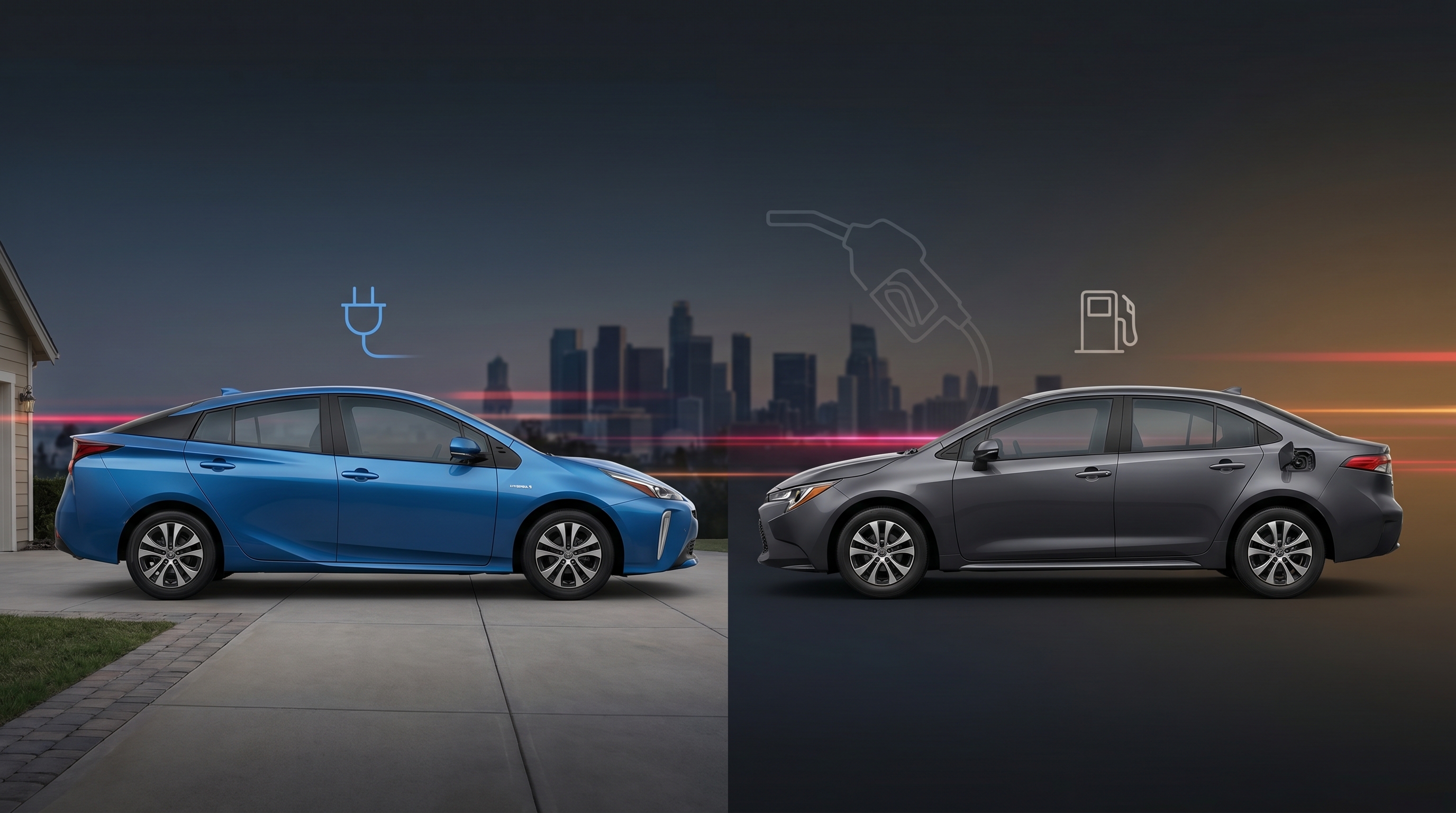
Buy the EV if you can charge where the car sleeps and your daily driving fits inside real-world winter range with a comfortable margin. Buy the hybrid if you cannot control where you charge, you drive long distances often, or you want the lowest-risk step away from a pure gasoline car. Four inputs decide most of this: charging access, commute length, winter range, and risk tolerance. Work them in order.
Gate 1: Where the car sleeps
Charging access comes before any spec sheet. If the car can charge overnight where it parks, an EV behaves like a phone: you leave home full every morning. If it cannot, every mile depends on public infrastructure, and that changes the math.
Three practical tiers:
- Home Level 1 (a standard household outlet): adds range slowly, often only a few miles per hour of charging. Workable for short commutes, painful as a sole method.
- Home Level 2 or workplace charging: the sweet spot. Overnight or workday charging covers most daily driving without thinking about it.
- Public charging as your primary method: the fragile case. It usually costs more than home electricity, availability varies by region, and you compete for plugs with everyone else.
If you rent, park on the street, or cannot install charging, lean hybrid. Before assuming public charging will carry you, check real charger coverage along your actual routes — the U.S. Department of Energy’s Alternative Fuels Data Center maintains a station locator for exactly this.
Gate 2: Size your commute against winter range, not the label
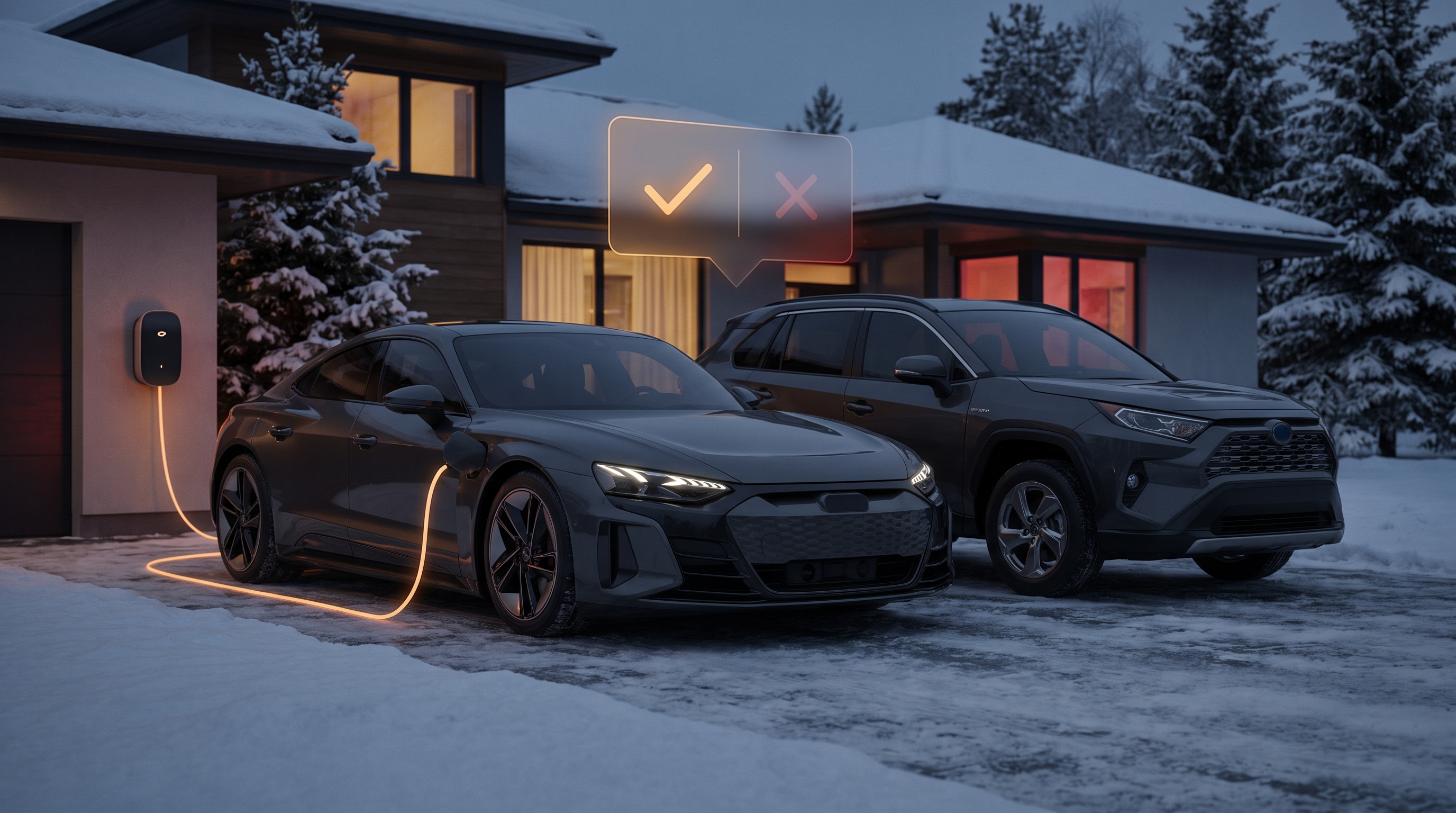
EV range figures are measured under standardized conditions. Your coldest mornings are not standardized. Cold weather reduces EV range and efficiency — cabin heating and battery chemistry both take a cut — and EPA’s fueleconomy.gov advises planning for reduced range and extra charging in winter.
Run the numbers twice:
- Add up your worst-case daily mileage: commute, school run, errands, everything.
- Compare it to the car’s range after a serious winter haircut, not the official figure.
- Keep margin. A commute that “just fits” the rated range will not just fit in January.
Illustrative example: a driver with a 40-mile round-trip commute and a car rated around 250 miles has slack to spare even on a brutal cold day. A driver with 120-mile days and the same car starts planning midweek public charging. Same battery, different lives.
Hybrids sidestep this gate. Cold weather hurts gasoline fuel economy too, but a hybrid still refuels in minutes anywhere gasoline is sold. That asymmetry — charging time versus pump time — is the core trade you are accepting.
Gate 3: Count the long days
Ask how often you drive beyond a single comfortable charge: road trips, family visits, towing, rural routes.
- A few times a year: an EV works if fast charging exists along your routes. You will stop longer and plan more, but for many corridors it is a solved problem.
- Monthly or more: a hybrid pays for itself in convenience. Drivers who road-trip constantly tend to feel every charging stop; occasional travelers do not.
- Remote or towing-heavy use: check charger coverage and towing behavior before committing. Both can be limiting in ways daily commuting never reveals.
Gate 4: Price your risk tolerance
Honesty time. The EV path asks you to adopt infrastructure: a charging routine, route-planning apps, network accounts, possibly an electrician visit. Some people enjoy that. Others want a car that asks nothing new of them.
The hybrid path asks for less and gives less: familiar refueling, no range planning, permanent dependence on gas prices and stations. If your gut says “I just want it to work the way cars have always worked,” that is a valid answer, and it points hybrid.
Risk tolerance also covers resale-value uncertainty, software expectations, and how you feel about being an early-ish adopter on your street. None of these is decisive alone. All of them color the four gates above.
The failure mode: the plug-in hybrid that never plugs in
The most common bad decision in this space is not choosing wrong between EV and hybrid. It is choosing a plug-in hybrid and then never plugging it in.
A plug-in hybrid delivers its advertised efficiency only when charged regularly. Driven uncharged, you haul a heavy battery around with a gasoline engine, and fuel economy drifts toward the conventional version, not the brochure. Buy a PHEV only if Gate 1 already passed — you have somewhere reliable to plug in nightly.
The mirror-image false read: treating the range label as a January promise. Plan a winter road trip against the official number, at highway speed, and you can arrive at a charger with less buffer than expected. Plan winter legs conservatively, or plan to be surprised.
The decision table
| Your situation | Better first fit |
|---|---|
| Overnight or workplace charging, commute fits winter range | EV |
| Street parking or no charging control | Hybrid |
| Long trips monthly or more | Hybrid |
| Long trips a few times a year on covered routes | EV is viable |
| First non-gasoline car, low appetite for new routines | Hybrid |
| Considering a plug-in hybrid | Only if you will genuinely charge it nightly |
Where CarSwype Match fits
The app earns its keep at the shortlist stage, not the verdict stage.
- Swipe with your fuel preference set to build instinct for what each side of the decision actually trades away.
- Save contenders from both camps — a couple of EVs, a couple of hybrids. Comparing across fuel types is the point.
- Use the compare view on two or three finalists and score them against your four answers: where it sleeps, your winter miles, your long-day count, your risk appetite.
- Write private notes recording your actual commute mileage and charging situation, so the comparison reflects your life, not a brochure’s.
Then take the shortlist offline. Confirm official fuel economy and range at fueleconomy.gov, verify current incentives at the IRS clean vehicle credits page if they matter to your budget, get a cold-weather test drive if you can, and price the electrician visit before committing. CarSwype Match organizes the decision; it does not replace the test drive, the inspection, or the official numbers.
What this framework cannot decide for you
- Range and charging outcomes vary by model, driver, climate, and date. This is directional logic, not a verdict on any specific car.
- Electricity rates, gas prices, and incentives differ by region and change often. Run your own local math before assuming savings.
- Nothing substitutes for seat time. If a winter test drive is possible, take it.
Four honest answers — where it sleeps, how far you drive in February, how often you go long, and how much novelty you want — and the EV-versus-hybrid question mostly answers itself.