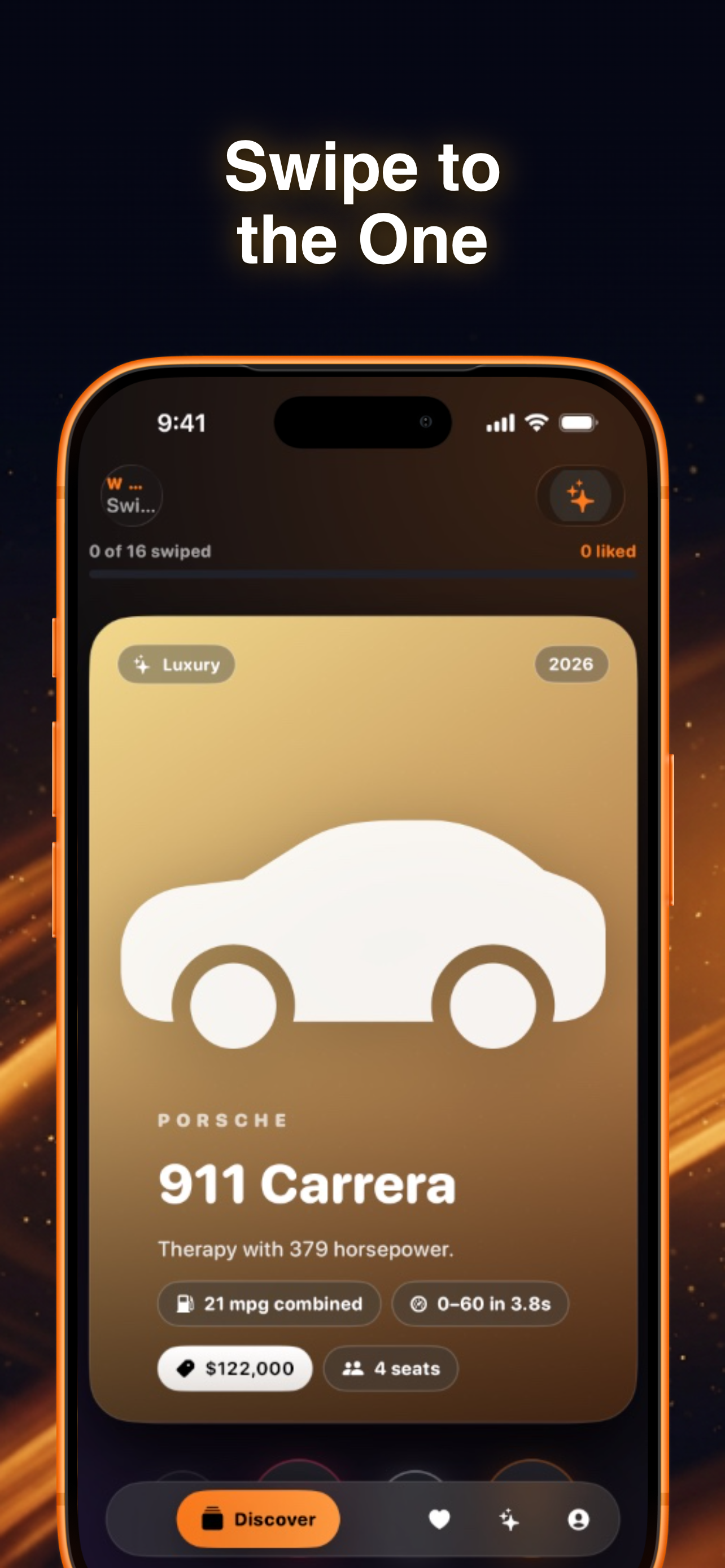
A swipe is not a final answer. It is a small reaction to one car, shown in one moment, under whatever assumptions the buyer brought into the session.
That is why a single yes or no should not carry much weight. The useful unit is the pattern: the cars that keep surviving, the categories that keep getting rejected, and the tradeoffs the buyer keeps making even before they can explain them.
CarSwype Match treats swipes as early evidence, not truth. The goal is not to turn a fast reaction into a verdict. The goal is to make the shortlist less random.
Repeated likes show the job the car is doing
Stated preferences are still useful, but they often arrive too early. A buyer may say “I need an SUV” when they really mean one of several different things:
- higher seating position
- room for a child seat
- space for weekend gear
- confidence in bad weather
- a car that feels more substantial than the one they have now
Those are different jobs. They only sometimes require the same vehicle.
Illustrative example: a buyer starts with “SUV” but keeps saving compact hatchbacks and smaller crossovers. The app should not immediately conclude that the buyer was wrong. It should ask what the liked cars have in common: easier parking, lower price, useful cargo space, better fuel economy, or simply a shape that feels less oversized.
Another illustrative example: a buyer says fuel economy is the priority, then repeatedly likes cars with stronger acceleration, quieter cabins, and more premium interiors. That does not mean efficiency stopped mattering. It may mean the real preference is “I want running costs to stay reasonable, but I do not want the car to feel bare-bones.”
This is where swipes help. They preserve the mismatch between what the buyer said and what they kept choosing. A good recommendation flow should not shame that mismatch. It should surface it as a useful question.
Passes draw the fence
Rejected cars are not wasted data. They show where the shortlist should stop expanding.
If a buyer repeatedly passes on large trucks, the app can treat size as a negative signal. If they keep rejecting two-door cars, rear-seat access may be a hard constraint. If every electric car gets passed, the issue might be charging access, winter range, apartment parking, road-trip anxiety, or simply unfamiliarity.
Important limitation: a pass does not always explain itself. A buyer may reject a car because of the price, the photo, the body style, the badge, the color, the interior, or one spec they noticed at the wrong moment. The signal gets stronger when the same kind of car keeps losing across multiple cards.
That is the practical value of a swipe deck. It turns scattered noes into a boundary.
Contradictions are where the shortlist gets smarter
The best shortlist work often happens when the pattern disagrees with the original plan.
Risky interpretation: “The buyer liked three sporty cars, so they must want performance.”
Better interpretation: “Performance may matter, but check what else those cars share. Are they also smaller, cheaper, cleaner-looking, or more premium inside?”
The same caution applies to any repeated signal. A string of SUV likes may point to cargo space, but it may also point to ride height or styling. Repeated hybrid likes may point to fuel savings, but they may also point to a buyer trying to avoid maintenance surprises. Repeated luxury likes may be about badge appeal, but they may be about seat comfort and cabin quietness.
Swipes reveal correlations first. The buyer still has to turn those correlations into reasons.
Notes turn reactions into decisions
Swipes are fast by design. Decisions are slower. That is why saved-car notes matter.
A note can capture the concern that does not fit a simple like or pass:
- “Great size, worried about winter range.”
- “Love the cabin, check insurance.”
- “Good price, but rear seat may be tight.”
- “Looks right, need to test parking visibility.”
Those notes are not decoration. They are the memory layer between discovery and comparison. Without them, the buyer has to reconstruct why a car made the list after the initial reaction has faded.
When the shortlist is down to two or three cars, the notes often matter more than another hour of browsing. They remind the buyer which tradeoff was already visible: price against comfort, range against charging access, performance against insurance, cargo space against parking, styling against daily practicality.
CarSwype Match is built around that rhythm: react quickly, save what matters, write down the unresolved concern, then compare the few cars that earned serious attention.
What a useful swipe pattern can and cannot do
A swipe pattern can narrow the field. It can show which categories deserve more cards and which ones probably do not. It can expose a preference the buyer had not named yet.
It cannot replace a test drive, inspection, financing review, insurance quote, or ownership-cost check. It also cannot know why a buyer reacted unless the pattern is paired with notes and later comparison.
That is the right division of labor. Let swipes handle early discovery. Let notes preserve the context. Let comparison make the tradeoffs visible. Then let the real car, real price, and real daily routine decide the rest.